Okay, so most people might not think feet are hugely important… but I came by my foot appreciation honestly. I was a ballet dancer, runner, skier, and soccer player growing up. I was always wrecking my feet. Also, barefoot was my preferred way of being. I noticed I felt better, and my feet felt better, not in shoes.
When I eventually ended up in medical school, I found I had a particular interest in the aging body… and I began to notice that foot health seemed to be related to how well my patients were experiencing their age.
I was not the only doctor to notice. In recent years the research has accumulated around just how much the structure, function, and pain in our feet impact the rest of our body, our quality of life, and especially how well we age.
All of this came home to me very recently when I was caring for my mother at the end of her life. Not living with her, I had not noticed that her feet had become slightly deformed and weak. That deformity and weakness greatly contributed to her changes in gait and balance, and this led to falls and fears of walking very far or much. She stopped getting exercise, and the increasingly sedentary lifestyle affected her circulation, her mood, her fragility, and her overall health. I wondered if it was affecting her brain function, as it led to neck and back issues that were reducing the circulation in and out of her brain — but, of course, moving less was also reducing her circulation as well as her strength. I wonder sometimes, if I had noticed and addressed her feet years ago, whether she would still be with me.
Our bodies, it is clear, are a collection of interlocking influences. So many things, though, start in our feet and work their way up. How our feet feel and function can determine far more than most of us have imagined.
What the research shows
- About one in five older adults has foot pain, aching, or stiffness on most days — in the Framingham Foot Study, 19% of men and 25% of women.
- Foot pain goes with slower walking and more trouble getting around — and how fast we walk is one of the strongest predictors of how long we live.
- Foot pain roughly doubles the odds of falling, and people who fall have 20–25% weaker toes.
- When foot pain was treated — orthoses, better shoes, and home foot-and-ankle exercises — falls dropped by 36%.
Up and down the chain
Problems with the hips and abdominal weakness can affect the feet. I have seen that in cases of foot pain, too many practitioners ignore the rest of the body's misalignments that could be affecting the feet and, conversely, many problems in the rest of the body (even up to the neck) respond to treatment better when the foot issues are resolved.
Research has traced some of these links. In large population studies, flat, low-arched feet are linked to knee pain, and foot pain on both sides travels with knee and hip pain. In people with knee arthritis, foot and ankle symptoms predicted worsening knee pain over four years. In women, feet that roll inward as they walk are linked to low back pain. And in dissection studies, the connective tissue on the sole of the foot is continuous with a line that runs up the back of the legs and along the spine.
And the question I asked about my mother's brain? Here is what we know. The fluid that bathes the brain drains out through lymphatic vessels to lymph nodes in the neck — traced in living people with MRI. In mice, that drainage slows with age, and blocking the veins that drain the head impairs the brain's clearance. In people, tucking the chin can narrow the jugular veins on imaging. And in large studies, people who walk more and sit less have a lower risk of dementia — even about 3,800 steps a day carried a 25% lower risk.
One finding stopped me. In mice — old ones included — light stimulation of the lymphatics just under the skin of the neck more than doubled the fluid draining from the brain. A light touch can encourage drainage.
Personally, this plus other studies, plus my 28 years in practice, is giving me a high confidence level that fluid flow in and out of the brain is having real impacts on cognitive function. Also, there is the fluid that leaves the brain in the venous return, the CSF that circulates down the spine, the arterial flow into the brain that provides oxygen and nutrients, and the circulation within the brain that may be affected by alignment, posture, and position, by fascial binding and muscle tension, and by overall circulation, breathing, and cardiovascular health.
Why feet hurt
The simple truth is that modern footwear, hard surfaces with no give that we stand and walk on, and a more sedentary lifestyle that does not strengthen certain muscles in the feet and legs all can contribute to foot pain. Plantar fasciitis is a good example of a painful condition that can be caused by weakness in calf muscles as well as myofascial binding in the foot and lower leg.
Feet that have weakness and/or pain and/or structural issues or neurological issues may do better at first in socks or athletic shoes that help and protect the feet and prevent injuries and falls. We can think of some socks and shoes as a kind of support system for vulnerable feet. Socks can have different benefits to different people. Socks can help warm and protect. Socks can be compression socks as well as non-slip socks. Different feet need different socks and different shoes. The ultimate goal for some people may be to strengthen and heal the feet so that going barefoot is healing, but it could take months to achieve that state, even if it is still possible.
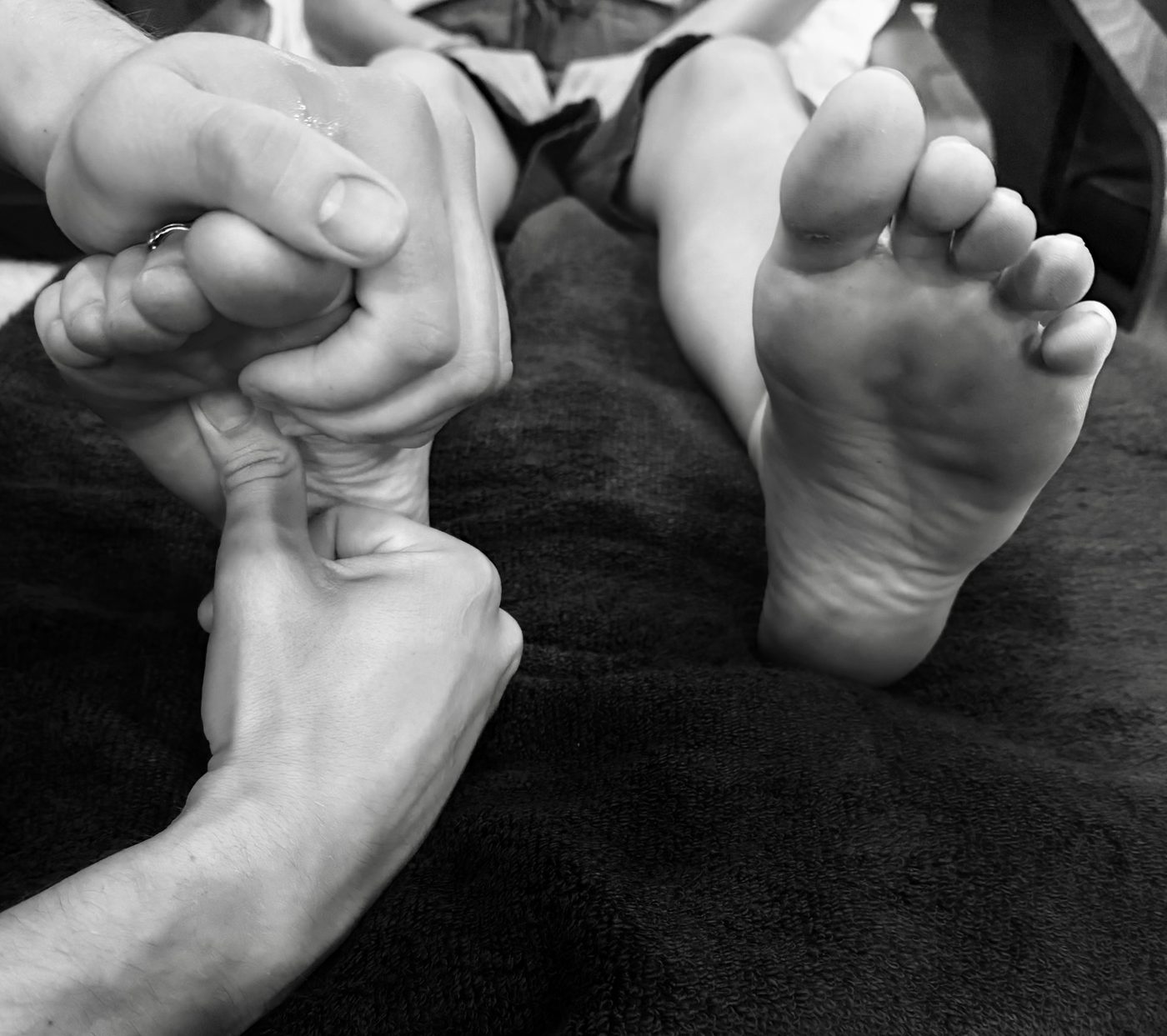
At the Barefoot Sage Center, we massage and stretch the stuck places and give strengthening exercises for the weak muscles.
Look at your feet
Some of the most telling signs are visible. Look at your bare feet, and watch how you walk (a phone video helps):
- Bunions — a bump at the base of the big toe
- Hammer toes — toes that bend and curl
- Fallen arches — the inner arch flattening to the floor
- Rolling in — ankles collapsing inward as you step
- Duck-foot walk — toes pointing out as you walk
A one-minute self-check
- Can you lift your big toe while the other toes stay down — and then the reverse?
- Can you spread your toes apart?
- Can you stand on one foot for 10 seconds, near something to hold on to?
- Is your first step in the morning painful?
Start where you stand
These are some of the simplest things you can do tonight. They are not necessarily the best — the best foot work is fitted to your feet — but they are a real start, and they are free.
A lot of foot issues need strengthening of the ankle and calf muscles. Doing stretches and strengthening at home is safe for many, but guidance and direction may be needed, particularly if there is pain, poor circulation, or balance concerns.
- Circle and write. Sitting, lift one foot and draw slow circles with your ankle, ten each way — or trace the alphabet with your big toe. Then switch.
- Grab. Spread a towel on the floor and scrunch it toward you with your toes. Or pick up marbles, or a handful of dry rice, and drop them in a bowl.
- Rise. Slowly come up onto your toes and lower back down, ten times. If you need support, hold on to anything that gives you balance. Not everyone needs to, or should. This one strengthens the calves and ankles.
- Roll. Roll the arch of your foot over a tennis ball — or a golf ball if you want it firmer — for a minute or two each side. Or work it with your hands.
Doing range-of-motion exercises and self-massage with hands or with a ball can reveal hidden areas of restriction, pain, or lack of strength. As you get stronger, more reps and balance exercises without holding on may be appropriate, but this should be tailored to you. What is too easy for one person may be too hard for another.
The foot is a complex apparatus, and it is often at the foundation, literally and figuratively, of the health of our bodies.
When to get help
- Numbness or burning
- A sore or wound that won't heal
- New swelling, redness, or warmth
- Pain that changes how you walk
- A fall, or a new fear of falling
— Dr. Sara Hazel
- Menz HB, et al. Foot pain and mobility limitations in older adults: the Framingham Foot Study. J Gerontol A Biol Sci Med Sci, 2013 — Framingham Foot Study, 1,544 adults: foot pain, aching, or stiffness on most days in 19% of men and 25% of women, with higher odds of mobility limitation. doi
- Studenski S, et al. Gait speed and survival in older adults. JAMA, 2011 — 34,485 adults aged 65 and older: faster walking speed tracked with longer survival. doi
- Stubbs B, et al. Pain and the risk for falls in community-dwelling older adults: systematic review and meta-analysis. Arch Phys Med Rehabil, 2014 — meta-analysis of 21 studies: foot pain carried 2.38 times the odds of falling. doi · Menz HB, Auhl M, Spink MJ. Foot problems as a risk factor for falls in community-dwelling older people: A systematic review and meta-analysis. Maturitas, 2018 — meta-analysis: older adults who fell were about twice as likely to have foot pain. doi
- Mickle KJ, et al. ISB Clinical Biomechanics Award 2009: toe weakness and deformity increase the risk of falls in older people. Clin Biomech (Bristol), 2009 — 312 adults aged 60–90 followed for a year: those who fell had roughly 20–25% weaker toes. doi
- Spink MJ, et al. Effectiveness of a multifaceted podiatry intervention to prevent falls in community dwelling older people with disabling foot pain: randomised controlled trial. BMJ, 2011 — randomized trial, 305 older adults with disabling foot pain: orthoses, footwear, and home foot-and-ankle exercises led to 36% fewer falls. doi
- Riskowski JL, et al. Associations of foot posture and function to lower extremity pain: results from a population-based foot study. Arthritis Care Res (Hoboken), 2013 — 1,856 adults: flat, low-arched feet were associated with knee pain. doi · Dufour AB, et al. Foot Pain in Relation to Ipsilateral and Contralateral Lower-Extremity Pain in a Population-Based Study. J Am Podiatr Med Assoc, 2017 — 2,181 adults: foot pain on both sides went with knee and hip pain. doi
- Paterson KL, et al. Longitudinal association between foot and ankle symptoms and worsening of symptomatic radiographic knee osteoarthritis: data from the osteoarthritis initiative. Osteoarthritis Cartilage, 2017 — 1,368 people with knee osteoarthritis: foot and ankle symptoms predicted worsening knee pain over four years. doi
- Menz HB, et al. Foot posture, foot function and low back pain: the Framingham Foot Study. Rheumatology (Oxford), 2013 — 1,930 adults: feet that roll inward as they walk were associated with low back pain in women. doi
- Wilke J, et al. What Is Evidence-Based About Myofascial Chains: A Systematic Review. Arch Phys Med Rehabil, 2016 — review of dissection studies: strong evidence for continuous connective tissue from the sole, over the heel, up the back of the legs and along the spine. doi
- Behnampour M, et al. The effect of remote self-myofascial release and stretch on range of motion and chronic neck pain: A randomized control trial. J Bodyw Mov Ther, 2025 — randomized trial, 32 people with chronic neck pain: self-massage and stretching of the calves and soles reduced neck pain. doi
- Eide PK, et al. Magnetic resonance imaging provides evidence of glymphatic drainage from human brain to cervical lymph nodes. Sci Rep, 2018 — 19 people: an MRI tracer in the fluid around the brain reached lymph nodes in the neck. doi · Da Mesquita S, et al. Functional aspects of meningeal lymphatics in ageing and Alzheimer's disease. Nature, 2018 — in mice, the brain's lymphatic drainage declined with age; impairing it slowed clearance and impaired memory, and improving it in old mice improved learning and memory. doi
- El Kamouh MR, et al. Cerebral venous blood flow regulates intracerebral pressure and brain clearance via meningeal lymphatic vessels. Nat Neurosci, 2026 — in mice, blocking the jugular veins impaired the brain's clearance and its lymphatic drainage. doi
- Ashraf O, et al. Incidence of dynamic internal jugular vein stenosis during cerebral venography: an updated analysis. Neurosurg Focus, 2026 — 223 patients evaluated for venous outflow problems: tucking the chin severely narrowed about three in four jugular veins studied. doi · Liu T, et al. Association of high-pillow sleeping posture with intraocular pressure in patients with glaucoma. Br J Ophthalmol, 2026 — a glaucoma study that also scanned 20 healthy volunteers: a high-pillow position narrowed the jugular veins on ultrasound. doi
- Del Pozo Cruz B, et al. Association of Daily Step Count and Intensity With Incident Dementia in 78 430 Adults Living in the UK. JAMA Neurol, 2022 — 78,430 adults: about 3,800 steps a day carried a 25% lower risk of dementia. doi · Raichlen DA, et al. Sedentary Behavior and Incident Dementia Among Older Adults. JAMA, 2023 — 49,841 adults aged 60 and older: more sedentary time went with higher dementia risk. doi
- Jin H, et al. Increased CSF drainage by non-invasive manipulation of cervical lymphatics. Nature, 2025 — in mice, light stimulation of the lymphatic vessels under the skin of the neck increased fluid outflow from around the brain, including in old mice. doi
- Holowka NB, Wallace IJ, Lieberman DE. Foot strength and stiffness are related to footwear use in a comparison of minimally- vs. conventionally-shod populations. Sci Rep, 2018 — people who habitually wore minimal footwear had stronger, stiffer feet than conventionally shod people. doi · Ridge ST, et al. Walking in Minimalist Shoes Is Effective for Strengthening Foot Muscles. Med Sci Sports Exerc, 2019 — randomized trial, 57 runners: eight weeks of walking in minimalist shoes strengthened foot muscles as much as foot exercises. doi
- Riddle DL, et al. Risk factors for Plantar fasciitis: a matched case-control study. J Bone Joint Surg Am, 2003 — plantar fasciitis case-control study: limited ankle dorsiflexion (tight calves) was the strongest risk factor; spending most of the workday on one's feet also raised risk. doi · Rathleff MS, et al. High-load strength training improves outcome in patients with plantar fasciitis: A randomized controlled trial with 12-month follow-up. Scand J Med Sci Sports, 2015 — randomized trial in plantar fasciitis: high-load strength training improved foot function faster than stretching. doi
- Koepsell TD, et al. Footwear style and risk of falls in older adults. J Am Geriatr Soc, 2004 — 327 older adults who fell and 327 who did not: falls were far more likely barefoot or in stocking feet; athletic and canvas shoes carried the lowest risk. doi
- Sherrington C, et al. Exercise to prevent falls in older adults: an updated systematic review and meta-analysis. Br J Sports Med, 2017 — meta-analysis of falls-prevention exercise: programs that challenged balance, with more than three hours a week, reduced falls by 39%. doi · Montero-Odasso M, et al. World guidelines for falls prevention and management for older adults: a global initiative. Age Ageing, 2022 — World Guidelines for Falls Prevention: progressive, individualized balance and strength exercise, with assessment and guidance for people at higher risk. doi